
Refuse derived fuel (RDF) trial proposal approved
The EPA initially approved the RDF trial proposal and the Adbri Kiln RDF Trial – Pre-Trial Report – 26 May 2026 on 6 July 2026.
The EPA was notified that the RDF Feed System to the Cement Kiln encountered commissioning issues, limiting the company’s ability to complete the approved trial program within the original timeframe.
Adbri has subsequently requested an amendment to the trial period to allow completion of the approved trial program. The EPA has assessed the application and approved a new trial with the same conditions as the prior approval. The revised trial period will now end on 27 October 2026.
While the end date of the trial will change, the number of hours that the trial will operate remains the same, as is the amount of RDF to be used. All other aspects of the trial in relation to testing, monitoring and community safeguards remain unchanged.
As the state’s independent environmental regulator, the EPA will ensure that the trial continues to be undertaken safely and is monitored in line with the approvals, including process stability, emissions assessments, and the uniformity / suitability of RDF.
For the duration of the trial Adbri must continue to implement additional air quality monitoring, including additional nitrogen dioxide monitoring and odour assessments in the local community.
Since the commencement of the trial, EPA staff have conducted announced and unannounced inspections of the Adbri facility, the Birkenhead and Peterhead areas and the RDF production site. As of the 19th August 2026, EPA monitoring and inspection of the trial has confirmed that it has been conducted in accordance with EPA approvals. The EPA will continue to monitor the facility for the duration of the trial. In addition, EPA air quality monitoring is continuing in the adjacent community, as is localised odour assessment work on the LeFevre Peninsula by EPA field staff.
EPA licence 1126 (Adelaide Brighton Cement Limited) provides clear protocols for the trialling of alternative fuels and raw materials (AFRM). Adbri is required to submit a pre-trial report outlining the duration and nature of the trial process, the nature of the RDF, the environmental emissions assessment and the production of a post-trial report at the completion of the trial.
View the Adbri Kiln RDF Trial – Pre-Trial Report – 7 August 2026 for more information.
The EPA’s regulatory focus is to assess and consider whether trials can be undertaken safely and that they are accurately assessed against required outcomes (i.e process stability, emissions, uniformity of AFRM). Importantly, the trial proposal assessment focused on ensuring no detrimental increase in key pollutants (ie inorganic oxides, heavy metals, organic emission compounds and volatile organic and polyaromatic hydrocarbons) as per the trial protocol.
During the trial period the EPA requires Adbri undertake additional monitoring of odour in the community by an external specialist odour consultant as well as additional nitrogen dioxide (NO₂) community monitoring for the period of the trial.
Completion of the trial does not constitute EPA approval for the ongoing use of RDF in the Birkenhead Cement Kiln or a variation of the existing licence.
The Refuse Derived Fuel (RDF) Standard
The EPA's Standard for the Production and Use of Refuse Derived Fuel (the RDF Standard) provides information to support resource efficiency and the beneficial recovery of energy from waste by the combustion of refuse derived fuel in an industrial process. This standard includes reference to the Waste Hierarchy, which outlines that the production and combustion of RDF is viewed as a recovery of energy activity and is seen as an alternative to disposal (the least preferable option) but should not be at the expense of preferable options, including waste avoidance or closed loop recycling.
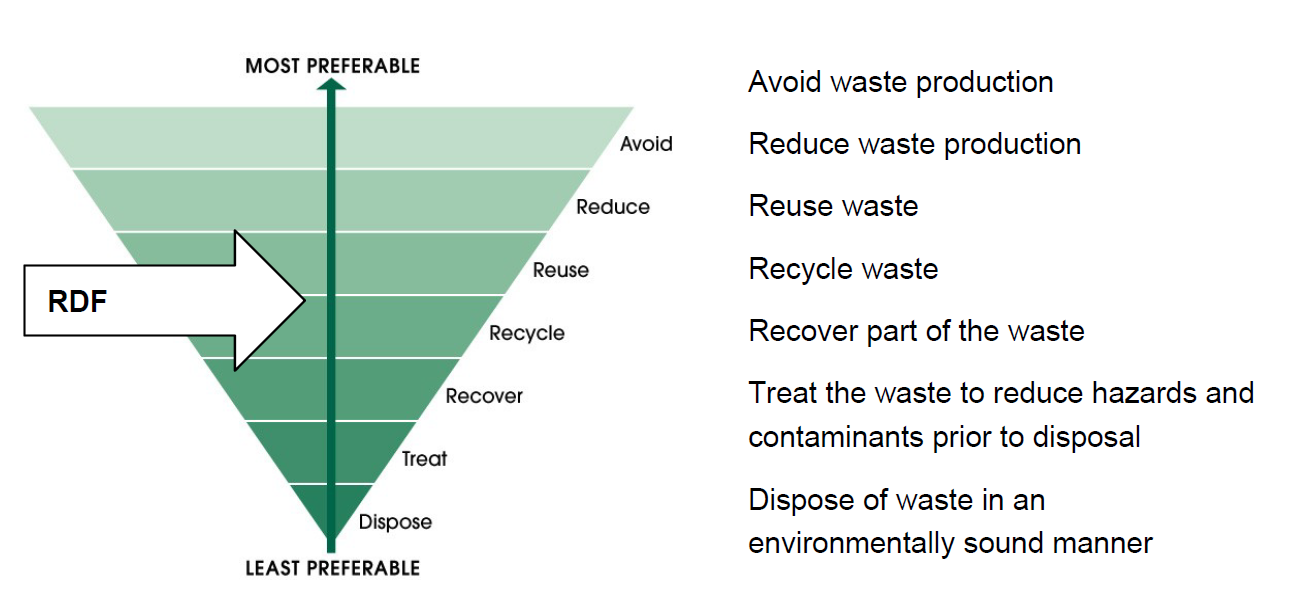
Current RDF Use in the Calciner
The Birkenhead plant is currently authorised to use up to 32 tonnes per hour (tph) of RDF into its Calciner with a maximum plastics content in the RDF of 20%. The RDF fuels the calciner, and together with natural gas operates between 850 – 890 degrees C. At this temperature limestone is decarbonised to lime (with carbon dioxide emitted) and the lime and other raw materials combine together and are transferred to the main rotary kiln where the cement clinker is formed.
Manufacture and Quality Control of the RDF
The EPA requires the RDF currently used in the calciner to meet the RDF Standard. All proposals for production and use of refuse derived fuel must be approved by the EPA.
The quality and consistency of the RDF must be maintained via a quality control and quality assurance (QC/QA) programme at the producer. This testing program is a key component of Adbri’s Recovered Product Plan (RPP) and the producer’s Environmental Management Plan (EMP) both of which have been approved by the EPA and the 20% maximum plastics content confirmed via sampling and analytical reports.
The approved calciner RDF product is a shredded mixture of timber, paper, cardboard, plastics, and other inert fibrous materials. The RDF is trucked to the Birkenhead plant on a “just-in-time" basis.
Frequently Asked Questions
Why has the trial window been amended?
The trial period has been revised after Adbri encountered commissioning issues with its RDF Feed System to the Cement Kiln, limiting the company’s ability to complete the approved trial program within the original timeframe.
Adbri has subsequently requested an amendment to the trial period to allow completion of the approved trial program. The EPA has assessed the application and approved a new trial with the same conditions as the prior approval. The revised trial period will now end on 27 October 2026
No other parameters of the originally approved trial will change, including the number of hours that the trial will operate and tonnages of RDF to be used.
How many hours will the trial run for now?
The trial is split into two stages, each with specific tasks and timeframes.
Stage 1 will occur across a 10-week period taking up to 96 non-continuous operating hours. The purpose of Stage 1 is to set up and confirm system capability of the RDF delivery and feed system.
Stage 2 will occur across a 4-week period, taking up to 72 non-continuous operating hours. The purpose of Stage 2 is to use RDF at commercial conditions while stack emissions testing is undertaken at different feed rates.
Was the community consulted in the change to the trial window?
Adbri is expected to continue to engage with the community in accordance with the trial conditions. The level of community engagement relating to the trial is unchanged from the original trial approval.
What is refuse derived fuel (RDF) and why is it used?
The RDF currently used in the Birkenhead calciner is an engineered fuel manufactured by Veolia ResourceCo at its dedicated facility in Wingfield and is comprised of Commercial and Industrial Waste (C&I), Construction and Demolition Waste (C&D) and Municipal Solid Waste Hard-Waste (MSW HW). The final RDF product is a shredded mixture of timber, paper, cardboard, plastics, and other inert fibrous materials.
The Birkenhead plant is currently authorised to utilise up to 32 tph of RDF into its Calciner with a maximum plastics content in the RDF of 20%. This equates to approximately 50% substitution of its main natural gas supply via the utilisation of refuse derived fuel (RDF). The RDF fuels the calciner, which operates between 850 – 890 degrees C.
How is the current RDF quality and consistency checked?
The EPA requires Veolia ResourceCo and Adbri to ensure the quality and consistency of the RDF is prepared and maintained to a specification and regulates this requirement in their licence via the preparation of an Environmental Management Plan (EMP) and Recovered Product Plan (RPP) respectively. The quality control and assurance (QC/QA) programme at Veolia ResourceCo and at Adbri’s Birkenhead National Association of Testing Authorities (NATA) accredited laboratory is achieved via a sampling, testing, and analysis program. This testing program is a key component of Adbri’s RPP and Veolia ResourceCo’s EMP, both of which have been approved by the EPA and the 20% maximum plastics content confirmed by the EPA via sampling and analytical reports provided.
How are emissions monitored when RDF is being burned?
The EPA requires Adbri to undertake specific stack emissions testing during any RDF trial period to measure the mass emission rate and concentration of the combustion emission pollutants. The suite of compounds specified in the licence (Schedule Y-1) are targeted to those pollutants associated with the use of RDF in the combustion process. These include inorganic and organic emissions compounds, chlorine and chlorinated hydrocarbons, heavy metals, polyaromatic hydrocarbons, dioxins and furans.
The stack testing over the period since commencement of RDF use in 2003 has demonstrated that the Environment Protection (Air Quality) Policy, 2016 emission criteria have been met. Additionally, the ambient emission levels in the local community must meet the National Environment Protection Measure (NEPM) for Nitrogen Dioxide, Sulphur Dioxide, Carbon Monoxide, Particulates PM10 and PM2.5 which are designed for ambient air quality that is protective of health. To date, Adbri has demonstrated that NEPM standards have been met for the use of RDF.
How much plastic is allowed in the RDF used by Adbri?
The EPA approved the original use of RDF in the Birkenhead Calciner in 2003 at a rate of 10 tonnes/hr with a maximum plastics content of 10%. The approval followed a closely monitored trial by Adbri with stack testing conducted on both the calciner and kiln, which reported no detrimental increase in inorganic oxides of the key pollutants and no increase in organic emission compounds and volatile and polyaromatic hydrocarbons. There was also no detrimental change in the heavy metal emissions relative to natural gas usage (which was the primary fuel).
In July 2017, the EPA approved an increase of RDF to 15 t/hr with a maximum plastics content of 20% following a successful trial of the RDF in the calciner at the higher rate. The stack testing program during the trial analysed Nitrogen Oxides, Sulphur Dioxide and Carbon Monoxide emissions, heavy metals, and organic emissions as well as dioxins and furans. The trial demonstrated no detrimental emission levels compared to the previous emissions for these compounds.
The current licence permits up to 32t/hr of RDF to fuel the calciner, with a maximum plastics content of 20%. In practice, the calciner operates at around 25t/hr.
Does the EPA conduct air quality monitoring in Birkenhead?
The EPA conducts real-time monitoring in Birkenhead at its Le Fevre #1 air quality monitoring site and at North Haven at its Le Fevre #2 site. This monitoring is for the smaller health-impacting particles less than 10 micrometres in diameter (PM10) and particles less than 2.5 micrometres in diameter (PM2.5) in the ambient air as part of its continuous air quality monitoring program across metropolitan Adelaide. One micrometre (µm) is 1 millionth of a metre or 1 thousandth of a millimetre.
Real-time public access to EPA data is available by visiting its Air quality monitoring | EPA
The EPA requires Adbri to undertake air quality monitoring in the community for Total Suspended Particulates (TSP), PM10 and PM2.5, and also Nitrogen Dioxide.
What are the processes following the Adbri pre-trial outcomes?
Following the trial, a post-trial written report is required to be submitted to the EPA within 90 days. A post-trial report would include results of stack testing and modelling, process stability and uniformity of alternative fuels and raw materials.
Following a successful post-trial assessment, Adbri may seek a process change application in accordance with conditions A5 and/or A6 of EPA licence 1126, for ongoing use. Development assessment requirements may also be triggered.
