
Edwardstown and surrounding areas Groundwater Prohibition Area
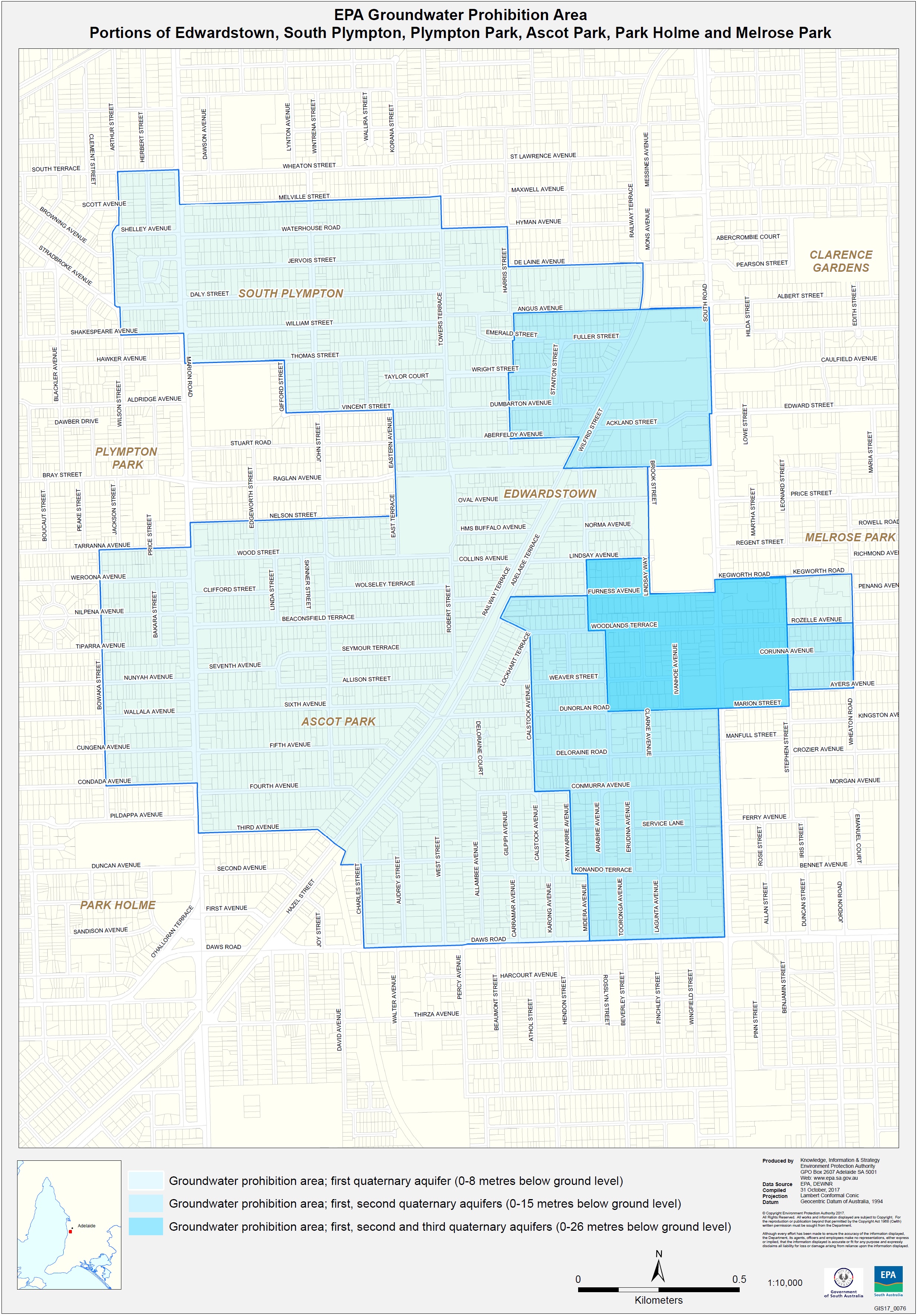
The EPA established the Edwardstown and surrounding areas groundwater prohibition area (Edwardstown GPA) in January 2018 to protect people from accessing contaminated groundwater. The main contaminants are chlorinated hydrocarbons (CHC), primarily trichloroethene (TCE).
Groundwater is water that is present underground within rocks or sediments and can be accessed by a bore with an outdoor pump. Most properties do not have access to groundwater.
The Edwardstown GPA was established on 9 January 2018 and published in the Government Gazette. The GPA extends to varying depths below ground level (please refer to the map).
Taking of groundwater is prohibited within the specified areas and a maximum fine of $8,000 may be issued to persons using groundwater at their property.
-
Community engagement report

The EPA implemented a comprehensive community engagement plan from 7 August 2017 to engage with residents, landowners and key stakeholders regarding a proposed groundwater prohibition area in Edwardstown and surrounding areas.
A range of methods were employed to seek feedback about the proposed groundwater prohibition area from individuals and organisations, including Government agencies, environment and community organisations, industry, and local residents and landowners.
The community engagement report summarises the community engagement process, feedback received, queries, and suggestions.
-
Do not use the bore water in this area
Groundwater (bore water) in this area should not be used for any purpose. Contaminants have been identified within the area, and include perchloroethene (PCE), trichloroethene (TCE) and its degradation products, dichloroethene (DCE) and vinyl chloride (VC). Additional chemicals of concern are heavy metals, cyanide and petroleum hydrocarbons.
Chlorinated hydrocarbons are extremely persistent in the environment and natural degradation is expected to take centuries worldwide. They are denser than water and leach through soil and groundwater. They are volatile, carcinogenic and present a potential risk to human health if groundwater is utilised for drinking, showering, washing, filling swimming pools, watering lawns or irrigation of edible produce. Operating a pump to extract groundwater can also draw contamination towards the extraction point, spreading contamination.
Historical chemical use has resulted in site contamination that affects soils on the source sites, groundwater on the source sites, and groundwater offsite in a west to north-westerly direction.
-
What is the risk to residents?

Poor quality and polluted groundwater can seriously threaten the health and viability of communities, agricultural operations and the environment. The EPA advises that the groundwater in this area is contaminated and should not be used for any purpose. Coming into contact with it can pose a risk to human health.
This is especially the case if you ingest it by drinking it, use it to water your fruit and vegetables, wash your food or cook with it (even if it’s boiled). If it’s used to water the garden or lawns, fill a pool or top up a rainwater tank, it creates the opportunity for dermal exposure to the chemicals of concern with absorption through the skin.
Contaminated groundwater should also never be used to wash down paths or the driveway or even as grey water such as toilet flushing. Preventing the extraction of contaminated groundwater is necessary to protect human health and also to prevent the spread of contamination. Spreading is caused by drawing water towards a property if the groundwater is being extracted from a bore.
-
 GPA Review – Stage 1
-
 Letter to bore owners – 17 December 2025 (290 KB) (pdf)
-
Stage 1 assessment report – September 2025 (11.8 MB) (pdf)
-
Stage 1 assessment report – September 2025_Appendices A-F (5.76 MB) (pdf)
-
Stage 1 assessment report – September 2025_Appendices G-M (12.8 MB) (pdf)
-
Letter to bore owners – 7 February 2025 (196 KB) (pdf)
-
-
GPA Establishment – 9 January 2018
-
 South Australian Government Gazette – 9 January 2018 (pp. 18–19)
-
 Media Release – EPA sets groundwater prohibition for Edwardstown – 12 December 2017 (290 KB) (pdf)
-
Edwardstown GPA fact sheet – 11 December 2017 (1.32 MB) (pdf)
-
Letter to residents – 11 December 2017 (744 KB) (pdf)
-
Edwardstown Community Engagement Report – November 2017 (1.2 MB) (pdf)
-
Invitation to community information sessions – September 2017 (252 KB) (pdf)
-
Edwardstown GPA fact sheet – 7 August 2017 (1.2 MB) (pdf)
-
Letter to residents – 7 August 2017 (703 KB) (pdf)
-
Map of groundwater plumes – August 2017 (845 KB) (pdf)
-
Site contamination overview fact sheet
-
-
Map – Edwardstown Groundwater Prohibition Area (2.92 MB) (pdf)
-
Proposed GPA Determination Report – December 2017 (6.02 MB) (pdf)
-
Animation video showing how past industrial wastes affected groundwater in Edwardstown and the demarcation of the groundwater prohibition area. More info - https://engage.epa.sa.gov.au/edwardstown-and-surrounding-areas